Dispatch #10: One Battle After Another: On the Destruction of Rainbow Crosswalks and Library Archives
Updated: Jan 1


October 19, 2025
Greetings from the Swamp.
I bike to the beach in a weekly attempt to temporarily clear my mind of the increasing political tumult that has swept over our swamp and increasingly engulfs the nation. Sitting on the sand, book in hand, listening to the waves lapping upon the shore grounds one. The sun’s heat kneads into one’s skin where humidity, flesh, brine filled breeze, and sand enfold into one another. But as the suns’ weight builds, one has the ocean close at hand to suddenly plunge into, cleansing one of the weight of the moment to temporarily become weightless, engulfed by its cool embrace.
Albert Camus, mostly known for his existential bleakness of The Stranger, frequently wrote about his love of swimming, the beach, and the ocean. “On the beach,” he reflects. “I flop down on the sand, yield to the world, feel the weight of flesh and bones, again dazed with sunlight.” Elsewhere, he describes the experience of swiming as bringing “his entire day a flavor of abandonment and joyful lassitude.” That sums up the experience well: the mutual sense of letting everything flow away while simultaneously embracing one’s singular existence, nothing more than flesh and bones.
In a less poetic vein, I think of Sensei Sergio St. Carlos, a marvelously disheveled yet Zen-like figure played by Benicio Del Toro in the brilliant recent Paul Thomas Anderson film, One Battle After Another (2025). With government-armed forces increasingly occupying cities as white supremacists extend their reach throughout the government and corporations (sound familiar?), Sensei reminds his charges that he is attempting to help escape: “Breathe. Ocean waves.” This is usually followed by two beers to assist them to achieve semi-relaxation. I immediately understood this guy.

But my beach excursions have recently been partially ruptured with yet another reminder of the encroaching tyrants that attempt to leave no stone unturned or in this case, no rainbow crosswalk un-sandblasted. In case you haven’t been following Swampland news, Department of Transportation had been directed in late June by the powers-that-be that there are to be no “non-standard surface markings, signage, and signals that do not directly contribute to traffic safety or control.” This is bureaucratic-speak for the need to remove all LGBTQ+ rainbow-colored crosswalks. Miami Beach was the most recent city forced to remove its Pride crosswalk or risk losing state funding.
The crosswalk in my hometown was established four years ago in memory of the Pulse nightclub shooting victims in Orlando. Its removal is part of a state-sanctified forgetting. It is a form of symbolic violence that erases difference and sandblasts away any aspects of history that don’t bolster a heteronormative state. Such an action disrespects the victims of the massacre while simultaneously insulting all those who felt the crosswalk attempted to signal a safe space for all.
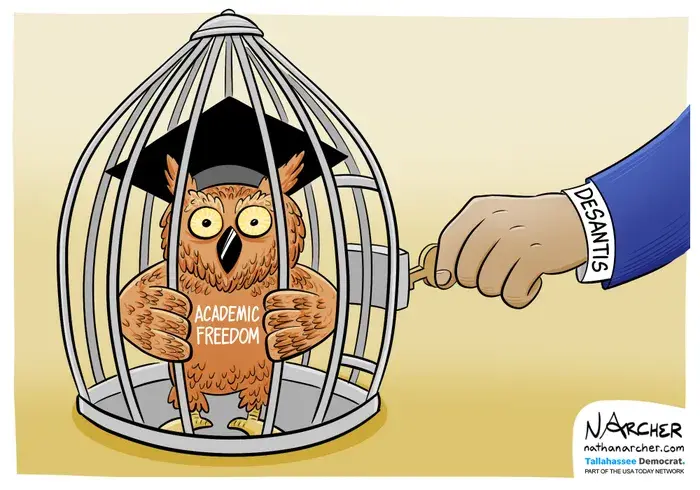
In a related fashion, a few weeks ago at Swampland University where I teach, a few faculty members were belatedly informed that our DVD library was being discarded. The DVD library built off of a fifty-year history that started with the acquisition of 16 mm films in the 1970s. Countless faculty, staff, students, and donors contributed to the library. Many of us still use it since, contrary to popular belief, many films and videos have not been digitized. Matter of fact, it is often the most vulnerable and marginalized of films and videos, those produced by non-profits, avant-garde artists, documentary filmmakers, and the like, that are at most risk of not being digitized due to limited resources, improper archiving, and lack of mass interest.
No faculty were consulted in advance regarding the removal of our DVD library. Librarians were barely kept in the loop with limited-to-no feedback. Understandably, many of them were too fearful to push back when they became aware of our collection being chucked out due to concerns over reprisals for engaging in such behavior. No one could offer me a clear sense of who was accountable for such a thoughtless action.
The ostensible reason for the removal of the DVD collection: to make room for government documents as a center for online learning needed space where those documents were once located. But like the removal of the rainbow-colored crosswalks, the symbolic meaning of this action gestures towards a similar disregard for the past. If it doesn’t bolster those in power, those aspects of the past can be thoughtlessly cast away. What such destruction means to communities outside of the rich and privileged can be shrugged off as collateral damage, another casualty for the power brokers’ quest to impose their vision upon the world.
This returns me back to One Battle After Another, a film of the present moment if there ever was one. Although it has some problematic gender and racial representations (particularly through its character Perfidia (Teyana Taylor)), the film captures more accurately than any Hollywood film I can recall the networked, lateral ways in which resistance operates. The true heroes of the film are not its stars, despite how captivating Chase Infinity as Willa can be. It is the vast web of unsuspecting resistance that features strongly within the film, not through an individual character, though Sensi comes close. It is through the families that harbor undocumented immigrants. It is the skateboarding kids who help Bob (Leonardo Dicaprio) flee the authorities. It is the two Hispanic boys who immediately take over an underground radio station to announce the DJ’s abduction by armed forces. It is the hospital workers who uncuff Bob to help him flee once again from the authorities.
The reason I can speak authoritatively about this is because I have been living down in the Swampland where our governor and his reactionary cronies are attempting to resurrect the ghosts of fallen conquistadors in their quest to locate El Dorado and the fountain of youth. The only reason I and many others like me can continue to work and live down here with any degree of success and not completely sell out our principles and our duties to our students and fellow human beings is because of the endless mutual assistance we receive from a similar network of resistance as seen in One Battle After Another.
Case in point: despite the DVD collection originally being set for immediate destruction without any faculty knowledge, someone reached out to faculty and gave us heads up. This allowed a band of us to rummage through the remains and save somewhere between 500-700 DVDs that we found vital to the collection. I don’t want to go into details about what exactly will be done with them, but an alternative DVD library will be created.
Meanwhile, as we sifted through thousands of DVDs throughout the last few weeks, many people expressed to me how proud they are of the work being done by our faculty union, which I and many others are a part of. Quite a few were people I had never met before or only knew in passing. But while we all commiserated with each other over the sorry state of affairs that confronted us while sifting through racks and racks of abandoned DVDs, our networks and connections grew and strengthened.
This is worth remembering: out of every tragedy an opportunity remains. We have the numbers and the endurance. They might have the power, for now. But it is only for the moment. It might feel like one battle after another. But winning the war is a different story.


Comments