Dispatch #12: Authoritarian Pre-Compliance and the Warping of Public Higher Education

February 19, 2026
Greetings from the Swamp.
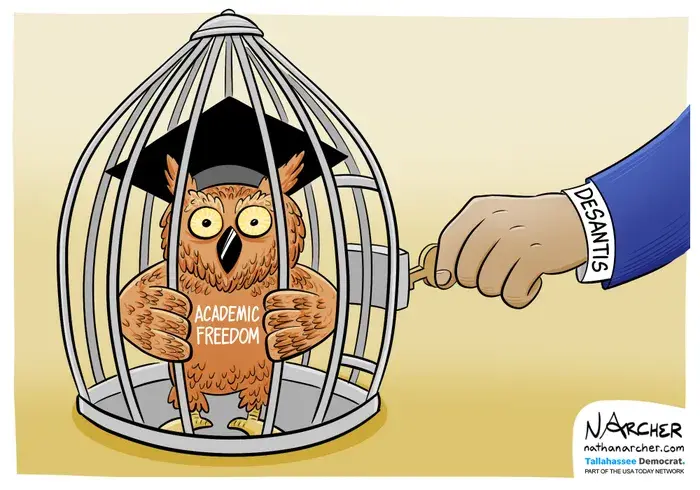
Ever since Florida became ground zero for the attacks against public higher education roughly five years ago, many misconceptions circulate regarding how academic freedom functions down here and the ways in which it is being compromised. A recent job candidate confided to a search committee member during a campus visit: “My advisor suggested I scrap my talk regarding gender and sexuality since he heard that you aren’t allowed to discuss such topics down here.” This is not the first time we have heard such rumors, which show how effective our state propaganda is regarding how “woke” research and teaching are being eliminated.
As I discussed in an earlier blog post, the state has engaged in psychological warfare in giving the illusion that all topics related to gender, race, LGBTQ+, and anything else that challenges a Eurocentric outlook has been scrubbed away from curricula and marginalized in terms of research. This is not true, which is not to say that certain disciplines and faculty holding more precarious employment are not being disproportionately targeted. Sociology has become the primary target regarding the state’s attack against diversity, equity, and inclusion.
For example, a new textbook has recently been issued for introduction to sociology courses that removes units on global inequality, race and ethnicity, gender and sexuality, and social stratification—the very core aspects that define much of the discipline of sociology.
How could this happen?
The Board of Governors decided that all current sociology textbooks violate state law regarding the banning of discussions of race, gender, sexuality , and oppression in general from all introductory courses, not simply sociology. A state working group was formed composed of four members from the Board of Governors and four sociologists from Florida International University, Florida State University, Daytona State College, and Florida Southwestern College. They were charged with creating a state sanctioned sociology textbook.
A month after the group’s creation, the sociologist from Florida Southwestern was removed from the working group since he wanted to include a unit focusing on gender. Florida Education Czar Anastasios Kamoutsas publicly berated the faculty member on social media, a tactic typical of Far-Right ideologues who use their public display of outrage and centralized power to serve as a warning to all others not to question their dogma. He further recommended that the faculty member be disciplined by the college’s president.
The reader might be perplexed as to how any sociologist would want to serve on such a committee. They must know that their presence on such a committee would lend it a certain legitimacy that it would otherwise lack. The sociologist from FSU serving on the committee stated, “This was the most unpleasant task I’ve ever had to take on in my entire career.” But the rationale the member offers for participating is revealing in displaying the bind that all faculty find themselves during an authoritarian moment:
As she saw it, either sociologists sat at the table to help create a new textbook, or colleges and universities across the state would be forced to remove Introduction to Sociology as a core course offered to incoming students. Carr said that scenario could lead to the overall implosion of the discipline in Florida and resulting job losses for professors and graduate students.
This is the power of pre-compliance, the modus operandi that dictates much of the way all colleges and universities operate within our swampy state. Those from the outside wonder how faculty and administrators can believe in such laws and actions that directly undercut the core tenants of higher education: academic freedom, due process, free inquiry, and faculty governance. The short answer is: they don’t.
The way to censor higher education is not to instill a belief in the legitimacy of a Far-Right outlook but instead to foster actions that comply with it. Attitudes don’t matter. The French theorist Louis Althusser long ago realized this when suggesting that ideologies are more based on practices than beliefs. He paraphrases the Catholic philosopher Blaise Pascal, “Kneel down, move your lips in prayer, and you will believe.”
But instead of religious dogma, we are now confronted with a political dogma that aids and abets white supremacy, misogyny, and a general disdain for anyone who doesn’t roughly align with an ethno-nationalist outlook. The idea behind this tactic is the long game: force people to contort their actions with a belief system that they initially don’t believe in for so long and so intensely that eventually their beliefs will eventually warp into alliance as well.
I will walk you through a typical experience of how pre-compliance works. Say some subject matter on your syllabus is targeted or a job search ad is flagged for language the whiffs of diversity, equity, and inclusion. You will not receive an email or any written form of communication from your Chair or Dean since they realize that such artifacts could be used as future evidence against them, a smoking gun pinpointing an exact moment where the university is sacrificing academic freedom for political theater.
Instead, you will be summonsed to the administrator’s office. (If you are fortunate enough to have a union, you will have someone accompany you to such a meeting. This action alone, having a witness to the encounter, is sometimes enough to deter an administrator from following throug). The administrator will tell you in all confidentiality that he disagrees with such policy, that he finds it abhorrent. But then he will quickly try to commiserate with you that you both need to come up with a mutual solution, that he doesn’t want to put the institution at risk. This, of course, overlooks how the institution is already at risk by sacrificing some of its core ideals for the hopes of obtaining future state funds by complying.
You might or might not come to an agreement since you are operating in the land of shadows. Because the administrator never issued an official directive for you to change your syllabus or the job search ad, you can simply reject it. You can’t be charged with insubordination since you weren’t given any directive to follow. Usually, the administrator offers that he is only making a “recommendation.” This is in part because the administrator has not received an official directive from those above him either.
If you ask the administrator to point you towards the document that justifies him in making such a recommendation, none is to be found. Instead, the administrator’s action is based off a loose and overly broad interpretation of a state law that is intentionally ambiguous. Many of the state laws in Florida directly contradict one another. For example, a law on “viewpoint diversity,” a conservative talking point that is less about a diversity of ideas than about allowing Far-Right ideas to take root in the classroom, directly contradicts other state laws that ban discussing race, gender and sexuality from classrooms. But most faculty and administrators understand that what might appear as a contradiction on paper are really there to sow uncertainty among educators and place them in the hopeless situation of constantly breaking state law no matter how compliant they might be.
After meeting with the administrator, the issue will be sent to his superior, who also might contact the faculty member for a meeting. Or it might simply disappear into the void until you belatedly discover that your syllabus or job ad has been altered in ways unbeknownst to you as it appears online. Because of such an outcome, you might be even less inclined to resist any future “recommendations” made of you since you know the outcome will be the same.
This is how practices gradually morph into beliefs through rationalizations and excuses, mea culpas and commiseration. Many of those issuing such pre-compliance “recommendations” suffer from a certain amount of delusion and egotism. They believe that if they are not there to ward off the worst of the changes to higher education, that if they weren’t present in their current role, someone worse might come along. But this overlooks a key reality: they are fostering a system that will increasingly push them out of their roles for a true believer to eventually take their place.
We are all ensnared in this insidious system working in public higher education in Florida. But the way we go about working within it is what truly matters. For those who feel secure enough, those with tenure, for example, we need to speak publicly against such actions. We need to call them out and not normalize them. In addition, we need to force the administration to make such changes themselves, not act in collusion with them hoping to stay under the radar and wait out this moment of reactionary populism. A wait-and-see attitude allows reactionaries and their backwards beliefs a firmer grip day by day to warp higher education into a reactionary vision where only the entitled are allow to attend and learn, where authoritarian control builds its strength and smothers knowledge in its pursuit of unilateral power.


Comments