Dispatch #11: State Capture of Public Higher Education in Florida: An Authoritarian Populist Playbook

January 2, 2026
Greetings from the Swamp.
As the new year takes hold, the attacks against public higher education continue. Those with their student loans in default could face having their wages garnished (though, The Debt Collective offers some helpful advice to avoid doing so). Harvard continues trying to negotiate a settlement with the Department of Education but keeps running up against an administration that seems more intent in holding the university in its crosshairs than making a deal. Other universities like Columbia, Cornell, and Northwestern all agreed to pay fines ranging from $200,000-$30,000 million. In August, the federal government demanded that University of California pay a $1 billion fine, which has been caught in litigation.
The American Association of University Professors has scored some court victories like having federal judges declare that the Trump administration’s ability to freeze Harvard’s funding and attempt to silence pro-Palestinian international students as clear violations of the First Amendment. But the attacks continue unabated in many locales.
Florida stands as ground-zero for the last five years as a bellwether for the tactics and strategies employed by an authoritarian populist regime in dismantling public higher education. The commercial news haphazardly understands this by occassionally writing articles that feature New College of Florida, the small liberal arts institution located in central Florida that the DeSantis administration hostilely took over in 2023. Republican Speaker of the State House, Richard Corcoran, was appointed its president and six new Board of Trustees were installed that included Christopher Rufo, who explicitly declared his war against higher education in a revealing 2025 New York Times interview.
But a recent article in The New York Times featuring the school reveals the limitations many journalists hold in understanding the complex picture of the ways in which public higher education has been systematically under threat in Florida. It features a professor who “reserves judgment” on the changes, most likely for fear of being retaliated against. It mentions “several veteran professors, who asked not to be named because they wanted to protect their jobs,” who suggested that “the college’s quirky identity is on the way out.” There is no mention of the mass purge of books related to gender and sexuality studies from the college, the arrest of its marketing director for exposing himself, or the denial of tenure of five professors after the school’s regime change.
The article represents a minimizing of the political attack against New College by quoting faculty and students who claim that they haven’t felt many significant changes. It ends with a student saying, “I think everybody minds their own business, does their own thing,” which clearly isn’t true for professors who are increasingly having their curriculum dictated by politicians rather by their own expertise. “Doing one’s own thing” serves as a self-protective coping mechanism many people find useful in attempting to ignore the constant chaos provoked by the Trump regime and populist reactionary politicians more locally.
Furthermore, the article underplays how New College is only one part of a larger pattern regarding the ways in which some conservative Florida politicians want to dictate the overall design of state public higher education. It also misses how the changes we have seen in public higher education in the United States are modeled upon earlier authoritarian populist attacks against higher education happening globally.
The edited collection, Neo-Nationalism and Universities: Populists, Autocrats, and the Future of Higher Education, offers an astute assessment of how attacks against public higher education in Hungary, Turkey, Poland, and elsewhere are serving as models for those occurring within the United States. Neo-nationalist outlooks target international students, gender studies, LGBTQ+ movements, and any other versions of history that challenge the power of those currently in control. Furthermore, according to John Aubery Douglass, “neo-nationalist leaders have pursued ways to alter the governance of universities with the objective of directly or indirectly choosing rectors or presidents and other key academic administrators” to dictate hiring, punish dissent, and deny funding to topics that imperil a populist reactionary outlook (34).
The Florida legislature has been consistently following this playbook during the past several years. It has enacted legislation in 2023 that attempted to dictate what could be taught until a judge deemed the “STOP WOKE” law unconstitutional. The state then changed tactics and targeted introductory classes to prohibit the teaching of systemic racism, sexism or any other form of oppression within them.
They deputized campus police to act in concert with Immigration and Customs Enforcement (ICE). For diverse campuses like mine where the student body is over 25% Hispanic with around 17% Black students, such actions force students to confront the very carceral state that they are hoping to escape. College no longer represents an alternative to such an outlook but instead bolsters it.
During the past few years, several university and college presidents, with limited-to-no experience in higher education, have been installed. Their connections to the DeSantis regime are well known. Manny Diaz Jr., a former state lawmaker, serves as interim president at University of West Florida. Former lieutenant governor Jeanette Nuñez oversees at Florida International University. Richard Cororan is president at New College. At Swamp University where I teach, we had an executive vice president of The Geo Group, a private prison company, installed despite significant student protest.
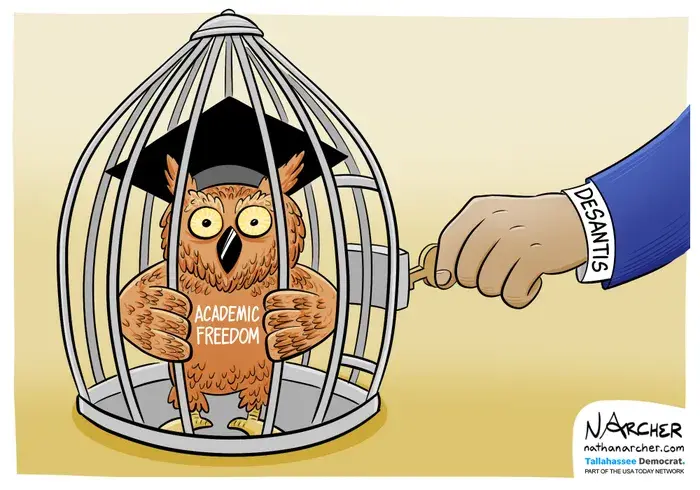
By placing political operatives in such positions of power paves the way for greater attacks against public higher education. Marbeth Gasman, a professor and associate dean for Research at Rutger’s University Graduate School of Education notes: “These shifts have led to the rise of presidents who are also seen as aligned with specific political agendas, and this can impact everything from academic freedom to campus culture.”
The most recent instance of this is taking place over the fight against accreditation, a normally mild administrative nuisance that most people outside of academia never heard of. During his first term, President Trump suggested that he would like to “fire the radical left accreditors.” Accreditation occurs every 10 years for universities and colleges to ensure that they meet basic standards and properly utilize student and taxpayer funds. It became a target for reactionary politicians in Florida in 2022 when the accrediting body, Southern Association of Colleges and Schools Commission on Colleges, called out University of Florida for jeopardizing academic freedom standards when three professors were prohibited by the school’s administration from testifying against the state’s proposal to change voting rights.
After this instance, the Florida legislature attempted to eliminate accreditation altogether, which a federal judge ruled against. Then it enacted a law that made universities and colleges change accreditors each cycle, an unnecessary and costly process. More recently, DeSantis announced the creation of a new accrediting body, The Commission for Public Higher Education(CPHE). As Katie Rainwater and Stacy Frazier point out, the “reform” of accreditation had been a key goal found in Heritage Foundation’s Project 2025 plan. It seeks to replace independent accrediting bodies with state-controlled ones that can help clear the path for more political meddling within the curriculum and general functioning of universities and colleges. Unsurprisingly, three Florida universities and colleges jumped on board in seeking accreditation with CPHE. Swamp University is one of them.
The creation of CPHE has been strongly opposed by teachers unions like the Florida Education Association and United Faculty of Florida. Rainwater and Frazier observe, “Politically powerful actors created the CPHE to enable the replacement of intellectually independent teaching and research with systems based in partisan ideology.”
As this new year dawns upon us, the fight over accreditation is sure to take on a central position in the battle over public higher education. But we must keep in mind how the changes in Florida belong to a systemic attack against public higher education not simply happening in Florida or the United States but globally where authoritarian populist regimes are attempting to secure their control by eliminating or severely compromising independent institutions, like universities and colleges, that democracies depend upon.


Comments